
DNS
DNS is a distributed, hierarchical naming system that translates names such as api.example.com into resource records containing information needed to locate or describe services.
Common usecase
- Maps names to IPv4 and IPv6 addresses.
- Directs mail delivery using MX records.
- Establishes aliases using CNAME records.
- Publishes service discovery information using SRV and other records.
DNS is an application-layer protocol, typically using UDP or TCP on port 53.
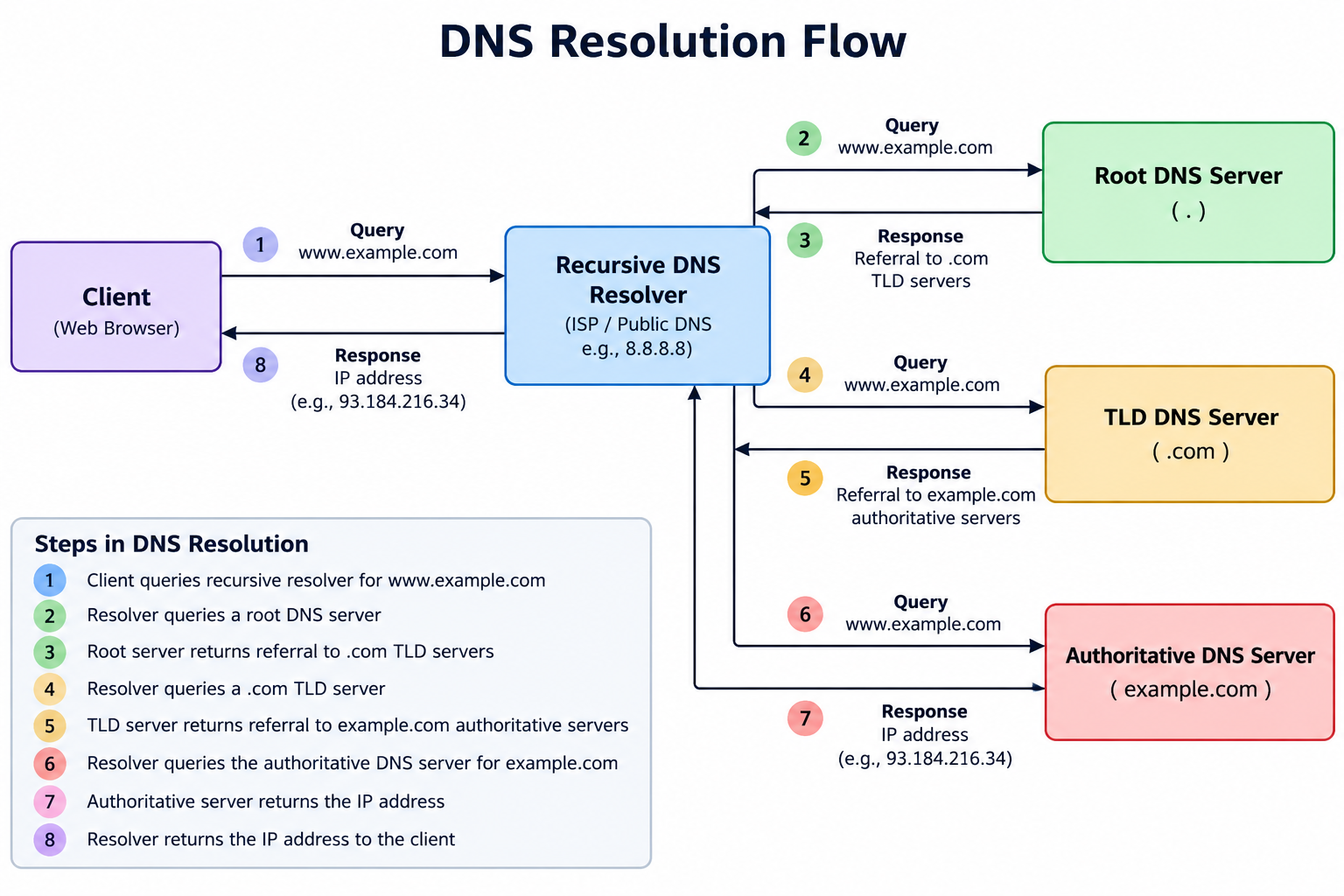
DNS names are case-insensitive for matching purposes, even though the original case may be preserved in some representations.
Heirarchy
api.example.comcom— a top-level domain (TLD)example.com— a domain whose zone is administered by its authoritative DNS operator.api.platform.example.com— the fully qualified domain name ( FQDN )
- Stub resolver: the component on the client or host that submits DNS queries to a configured resolver.
- Recursive resolver: accepts a query on behalf of a client and obtains the answer, using cached data or querying other DNS servers.
- Root server: provides referrals toward the relevant TLD nameservers. It generally does not answer with the final IP for an ordinary application hostname.
- TLD nameserver: provides delegation information directing the resolver toward the authoritative nameservers for a domain.
- Authoritative nameserver: serves the records for a zone for which it is authoritative.
Recurssive vs Iterative
A normal application usually makes a recursive request to its resolver. The resolver performs iterative lookups through the DNS hierarchy as needed.
- Recursive query: the requester asks the resolver to obtain a complete answer or a definitive negative result.
- Iterative query: the server responds with what it knows, which might be a final answer or a referral to another nameserver.
A DNS resource record is conceptually a tuple
NAME              TTL  CLASS  TYPE  RDATA
api.example.com. 300 IN A 203.0.113.20DNS records: know the ones that matter
| Record | Purpose | Typical use |
|---|---|---|
| A | Maps a name to an IPv4 address | IPv4 service endpoints |
| AAAA | Maps a name to an IPv6 address | IPv6 service endpoints |
| CNAME | Aliases one name to another canonical name | Managed service endpoints |
| NS | Identifies authoritative nameservers | Zone delegation |
| MX | Specifies mail exchangers with priorities | Email delivery |
| PTR | Reverse name mapping from an address | Reverse DNS and diagnostics |
| SRV | Advertises a service target and port | Protocol-aware service discovery |
| HTTPS / SVCB | Advertises service connection parameters | Modern service and HTTP endpoint discovery |
A and AAAA
These are the basic address record types. A hostname can have multiple A or AAAA records, but clients and resolvers differ in how they order, select, and use them. Returning multiple a client may choose one address, attempt another only after failure, or apply address-selection behavior of its own.
CNAME
A CNAME makes one DNS name an alias of another. The resolver follows the alias to obtain the requested data for the canonical name.
DNS caching and TTL: the heart of DNS performance
A record's time to live (TTL) specifies how long a resolver can ordinarily reuse that cached record before it needs to refresh it.
Positive caching vs. negative caching
There are two important categories
- Positive caching: the resolver caches returned records such as A, AAAA, CNAME, NS, or MX.
- Negative caching: the resolver caches that a requested name or record does not exist.
- Negative caching can improve efficiency substantially, but a deployment that assumes “record added means immediately resolvable everywhere” can fail in confusing ways.
- NXDOMAIN: the queried name does not exist.
- NOERROR with no matching requested record (often called NODATA): the name exists, but there is no record of the requested type.
- Negative caching can improve efficiency substantially, but a deployment that assumes “record added means immediately resolvable everywhere” can fail in confusing ways.
TTL
Choose TTL values based on the operational goal, record stability, DNS provider behavior, and consequences of stale resolution.
- A short TTL can make legitimate routing changes visible sooner to cooperative resolvers, but it also increases query volume and dependency on DNS availability.
- A long TTL reduces repeated queries and can improve resolver efficiency but means old answers may persist longer during planned changes or failures.