
Metadata Design: HTTP Headers and Media Types
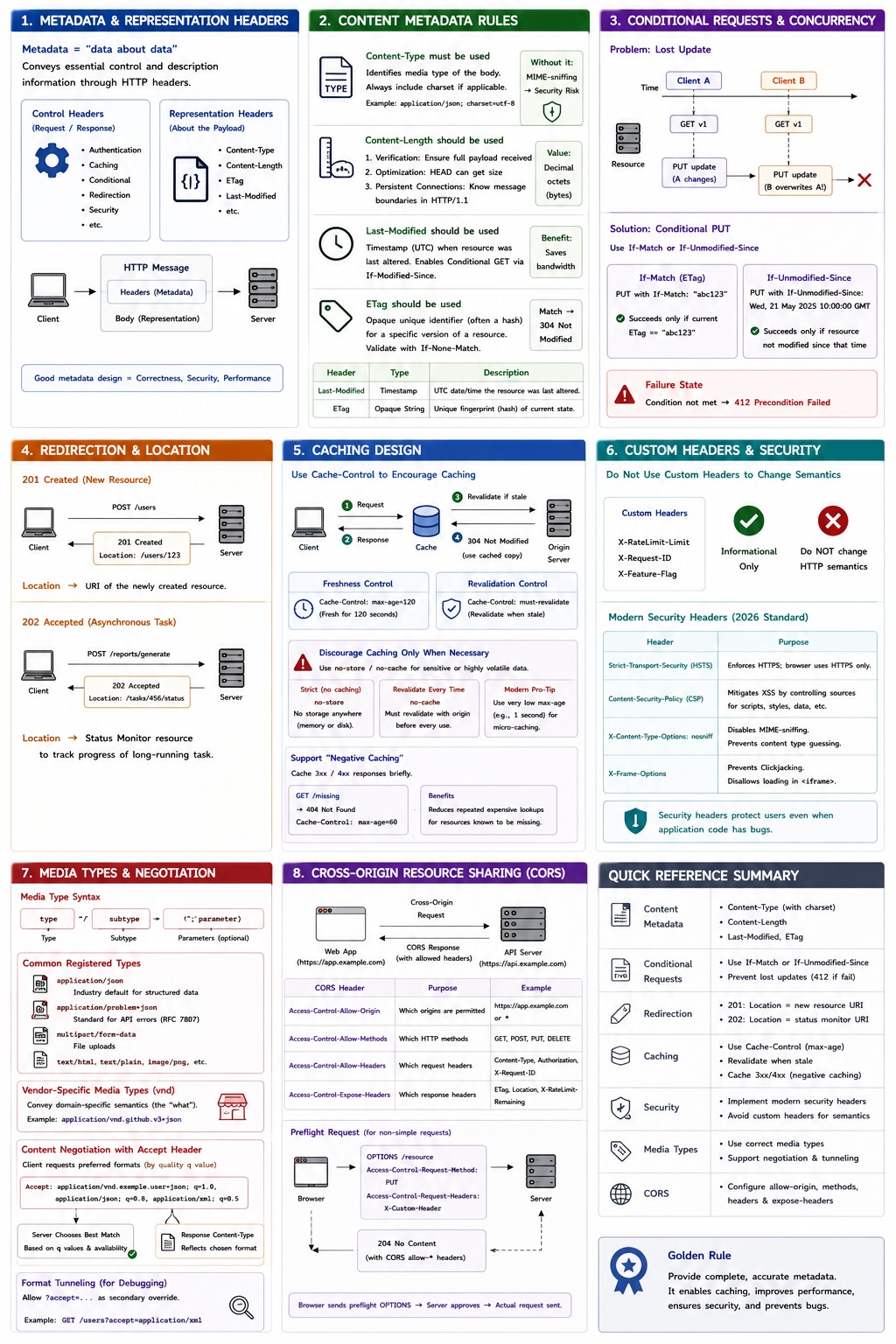
1. Metadata and Representation Headers
Metadata in HTTP serves as the "data about data," conveying essential information through headers. Modern REST architecture distinguishes between Request/Response headers (control info) and Representation headers (description of the payload).
2. Content Metadata Rules
Rule: Content-Type must be used
The Content-Type header identifies the media type of the message body. Without it, recipients are forced to perform "MIME-sniffing," which is a significant security risk (e.g., executing a .txt file as a .js script).
- Standard: Always include the character encoding if applicable (e.g.,
application/json; charset=utf-8).
Rule: Content-Length should be used
This header specifies the size of the body in decimal number of octets (bytes).
- Verification: Allows the client to ensure the full payload was received.
- Optimization: Allows a
HEADrequest to determine file size without a full download. - Persistent Connections: Crucial for HTTP/1.1 keep-alive to know where one message ends and the next begins.
Rule: Last-Modified should be used in responses
A timestamp indicating when the resource was last altered. This enables "Conditional GET" requests via the If-Modified-Since header, saving bandwidth if the resource hasn't changed.
Rule: ETag should be used in responses
An ETag (Entity Tag) is an opaque, unique identifier (often a hash) for a specific version of a resource.
- Validation: Clients store the
ETagand send it back in future requests usingIf-None-Match. If the server's currentETagmatches, it returns a 304 Not Modified, instructing the client to use its cached version.
| Header | Type | Description |
|---|---|---|
Last-Modified | Timestamp | The UTC date and time the resource was last altered. |
ETag | Opaque String | A unique fingerprint (hash) of the resource's current state. |
3. Conditional Requests and Concurrency
Rule: Stores must support conditional PUT requests
Store resources (client-managed) use PUT for both creation and updates. Without conditional headers, a "Lost Update" problem occurs where two clients overwrite each other's changes.
- Implementation: APIs must require
If-MatchorIf-Unmodified-SinceforPUToperations.If-Match: Ensures the client is updating the version they originally retrieved. The operation proceeds only if the currentETagmatches the one provided. If not, the server returns 412 Precondition Failed.If-Unmodified-Since: Prevents updates if the resource state has shifted since a specific time. The operation proceeds only if the resource hasn't changed since a specific timestamp.
- Failure State: If the condition is not met, the server returns 412 Precondition Failed.
4. Redirection and Location
Rule: Location must specify the URI of new resources
The Location header is mandatory for 201 Created responses to point the client to the newly minted URI.
- Asynchronous Tasks: In a 202 Accepted response,
Locationshould point to a "Status Monitor" resource where the client can track the progress of the long-running operation.
5. Caching Design
Caching is the primary mechanism for improving REST API scalability and reducing latency.
Rule: Use Cache-Control to encourage caching
The Cache-Control header is the modern standard for defining cacheability.
max-age: Defines freshness in seconds.must-revalidate: Instructs the cache that once a resource becomes stale, it must be re-validated with the origin server before being served.
Rule: Discourage caching only when necessary
Use no-store and no-cache to prevent sensitive or highly volatile data from being stored.
- Use
no-storeto prevent any caching (including the browser's disk cache) - Use
no-cacheto force revalidation every single time.
Cache-Control: no-store, no-cache, must-revalidate- Modern Pro-Tip: Instead of
no-cache, use a very lowmax-age(e.g., 1 second). This allows for "micro-caching," which can absorb thundering-herd traffic spikes without sacrificing data freshness.
Rule: Support "Negative Caching"
Apply Cache-Control headers to 3xx and 4xx responses. Caching a 404 Not Found for a short period (e.g., 60 seconds) prevents repetitive, expensive lookups for resources known to be missing.
6. Custom Headers and Security
Rule: Do not use custom headers to change HTTP semantics
Custom headers (formerly prefixed with X-, now deprecated per RFC 6648) should only be used for informational purposes (e.g., RateLimit-Limit). They must not be required for basic protocol compliance.
Modern Standard: Security Headers
Every REST API in 2026 should implement:
Strict-Transport-Security(HSTS): Enforces HTTPS, forces the browser to use HTTPS onlyContent-Security-Policy(CSP): Mitigates XSS, by limits where the browser can load scripts and data fromX-Content-Type-Options: nosniff: Disables MIME-sniffing i.e prevents the browser from trying to guess the Content-TypeX-Frame-Options: Prevents Clickjacking by disallowing the API documentation or UI from being loaded in an<iframe>.
7. Media Types and Negotiation
Media Type Syntax
The formal syntax for a media type is:
type "/" subtype *( ";" parameter )$$Common Registered Types
Common types include application, audio, image, text, and video.
application/json: The current industry default for structured data.application/problem+json: The standard for communicating API error details (RFC 7807).multipart/form-data: Used for file uploads.
Vendor-Specific Media Types (vnd)
Used to convey domain-specific semantics. While application/json tells you the syntax is JSON, a vendor type tells you the schema.
Vendor-specific types describe the semantics (the "what").
- Example:
application/vnd.github.v3+json
Rule: Support Content Negotiation
Clients use the Accept header to request specific formats.
Accept: application/vnd.example.user+json; q=1.0, application/json; q=0.8The q parameter (Quality Value) allows the client to rank preferences.
Rule: Support Query Parameter "Tunneling" for Debugging
While headers are the standard, allowing ?accept=application/xml facilitates testing via browsers and simple curl commands. This is known as Format Tunneling and should be treated as a secondary override.
8. Cross-Origin Resource Sharing (CORS)
When an API is accessed from a browser-based frontend on a different domain, the server must provide CORS headers.
Access-Control-Allow-Origin: Defines which domains are permitted.Access-Control-Allow-Methods: Defines permitted verbs.Access-Control-Allow-Headers: Lists which custom headers can be sent.Access-Control-Expose-Headers: Allows the client to read custom headers likeETagorLocation.