
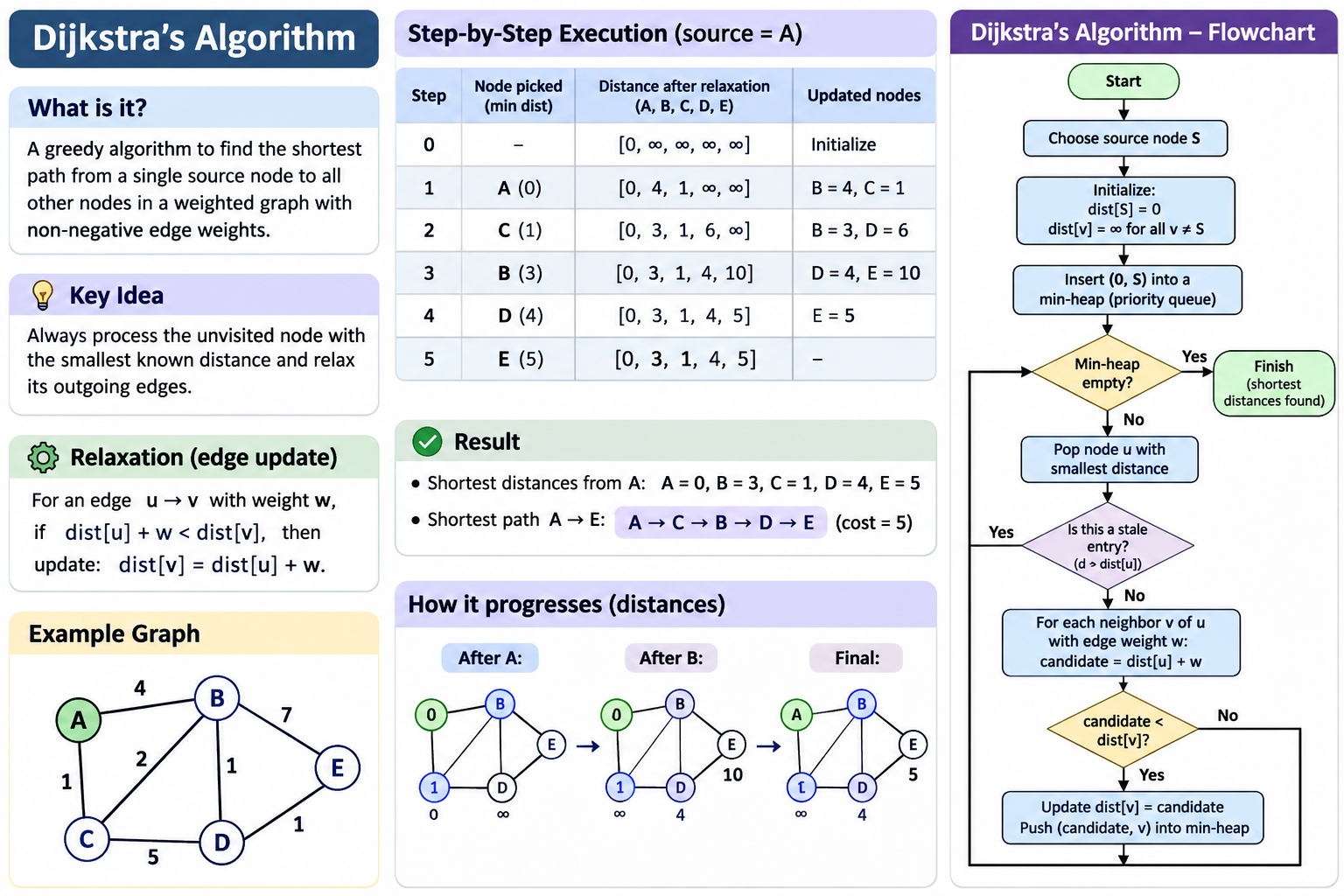
Dijkstra's Algorithm is used to find the shortest path in a weighted graph when all edge weights are non-negative.
Works on directed and undirected graphs.
Look for these clues:
- Minimum distance, cost, time, or effort to reach a destination.
- A graph or grid where edges have different weights.
- Need to find the shortest path from one source to other nodes.
- Edge weights are non-negative
Tip
If you need to minimize the total cost of a path in a weighted graph with non-negative edge weights, think Dijkstra.
Dijkstra uses two main concepts:
- Greedy:
- Always process the currently closest unprocessed node.
- Because edge weights are non-negative, once the closest node is selected with its current best distance, no future route can make that distance smaller.
- Relaxation
- Update a neighbor if going through the current node gives a cheaper path.
Dijkstra is not always about adding distances. The priority queue can prioritize different path costs when the problem has a suitable greedy property.
Algorithm using a min-
At every step, Dijkstra needs to select the node with the smallest tentative distance.
function Dijkstra(Graph, source):
    create distance[] and set all to infinity
    distance[source] = 0
    create a priority queue Q

    while Q is not empty:
        u = vertex in Q with smallest distance
        remove u from Q

        for each neighbor v of u:
            alt = distance[u] + weight(u, v)
            if alt < distance[v]:
                distance[v] = alt
                update v in Q with new distance

    return distance[]
A min-heap allows us to retrieve that node efficiently.
Operations:
- Push a node:
- Pop the minimum: